‘Dare to be different’ was exclaimed by either Tom Ford or Coco Chanel, both prominent fashion designers, and there is great merit in that statement.
Don’t follow the crowd; don’t bow to peer pressure; make your own path.
The art of theater, as opposed to other art forms, provides exactly that opportunity; we have seen all sorts of variations of theater production over the decades, way too many to list them here.
And that is a good thong.
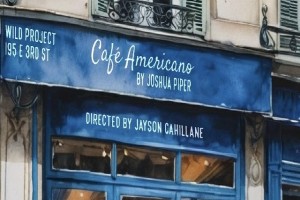
Certainly, Joshua Piper, author of the play ‘Café Americano’, now playing at the Fresh Fruit Festival in the Lower East Side, has taken that mantra to heart, with decidedly mixed results. Like most things in life, a play is neither altogether terrific, nor altogether horrible; it is usually a blend of hits and misses, of elements that work and attempts of elements that don’t, of a hue of gray that kind of represents the journey and struggles of life.
That is the case here; some of it, no doubt, was avoidable. The first area of opportunity was in the casting: Mr. Piper the playwright has decided to portray the character–Texas, a playwright–himself, and this is always, always a mistake.
Second are the biographical building blocks of this character, which, for the most part, defied any sort of credibility. The loose plot seemed to be–seemed to be–that Texas has had success with his (first?) play, and is up for Tony consideration (we think, mentioned once in passing, very quickly, and almost inaudible), and has now decided to avoid the publicity and crowds and jetted off to Greece and then Paris, for reasons unknown.
A few things: there is no 24-year-old playwright alive who has an agent, let alone who has written a play that is up for Tony consideration.
Second, the playwright, well-meaning of course, does not indicate any unusually gifted ear for dialogue or exposition, or play structure, or story-telling as himself, so how is it possible that a play, emanating from his imagination, would suddenly rise triumphantly from the ashes, and be the Next Great Thing in Theater? Not likely.
Third, Mr. Piper, unfortunately, for him and the production, does not act the role specifically written for him well. He seemed over his head, and wound up describing his many emotions and feelings, rather than actually emoting, or feeling. He was, sad to say, not believable as a person torn seven ways to Sunday (or later, when falling in love) for one moment. Not one. Looking back, the wiser move was to show up Opening Night with a program in one hand, and a martini in the other, and simply enjoy his opening and the fruits of his labor, always a thrilling moment for any playwright. However, that did not occur.
Happily, the play takes an upward turn in the second half…coincidentally or not, when Mr. Piper is barely on the stage. Hanging out at the café in the title, he runs into the character San Francisco, well played by Micaela O’Rourke, a recent transplant from the states. Here, the play takes a pleasantly unexpected turn–Mr. Piper’s character hands the baton of his narration over to Ms. O’Rourke, and the results are scintillating. Bravo to the playwright here; a nice, deft theatrical convention properly depicted, with all the trimmings of a meaningful theatrical endeavor. Now the trick was to connect the two parts of the play, into one, larger, whole.
Came pretty close. Both characters discover they are sleeping with the same person: her husband. Here, as the play reaches its denouement, the playwright struts his stuff the best: the wife confronts with husband with one lonely, lovely sentence, followed by a quick blackout; this was the high point of the play, and expertly crafted by both Ms. O’Rourke (and the husband, the decent but barely heard from Hudson Brown), and the director Jayson Cahillane (we think; two ‘associate directors’ also credited, highly unusual…but, dare to be different)
The ending of the play is syrupy, and not worth mentioning…but also, in the grand scheme of things, not that particularly important. Mr. Piper certainly made his own path, and only will get better with more experience, determining what works, and what doesn’t.
 OUTER-STAGE