RADIANT VERMIN by Philip Ridley.
Ripple Effect Artists examines the housing market and homelessness in a most fantastical way with Radiant Vermin by Philip Ridley. Running June 19 – 30 at The Sargent Theatre of the American Theatre of Actors, 314 W. 54th St. New York City.

In this “Twilight Zone” style play, a young couple is offered an ideal house by a mysterious stranger. Imagine Rod Serline then popping out and asking: “How far would any of us go to get our dream home?” This fast-paced, pitch-black comedy features a young vibrant cast provocatively satirizing the housing market, homelessness, and inequality. Imagine a magical Cash Jordan!
We spoke with the cast — MATT BRADDAK, MIMI BRILL, and MEJIAH — and the director — KIMBERLY LOREN EATON.
Tickets available at rippleeffectartists.com.
What initially drew you to this script?
EATON: Playwright Philip Ridley has a brilliant, irreverent sense of humor, and the Brits have a way with satire that we rarely see in the U.S. Radiant Verminis absolutely a play with a message but it is delivered through a wild, hilarious ride of a story, not through finger-wagging or hitting the audience over its heads with a lesson.
What tools are you using to bring these characters to life?
EATON: A big initial conversation for me with Jessie Fahay, the Artistic Director of Ripple Effect Artists, was about the goal of the production. So many companies produce work without knowing what they want to say with a production or season, whereas Ripple Effect is really clear about that. So, Jessie and I talked a lot about homelessness and gentrification, the theme of Ripple Effect’s current season, and I read the play with that in mind a few times. We talked about making the play as relevant as possible for our audience, here, in NYC. We’re facing a homelessness and an affordable housing crisis here, so in an effort to make the play feel as connected to this place and time as possible for audiences, we are setting the play in urban America in 2024, making the very conscious decision to not use British accents, as we didn’t want the circumstances Jill and Ollie experience in the play to feel removed from our audience’s reality. One statistic I came upon in my research was that LGBTQ+ youth are more than twice as likely to become homeless than other young people. “28% of LGBTQ+ youth”– that’s nearly a third!– “reported experiencing homelessness or housing instability at some point in their lives– and those that did had two to four times the odds of reporting depression, anxiety, self-harm, considering suidcide, and attempting suicide compared to those with stable housing.” (The Trevor Project) 1.6 Million youth are homeless each year, and up to 40 percent of them identify as LGBTQ+. Because LGBTQ+ youth represent only 7 percent of the total youth population, there is a staggering disproportion of homelessness among these populations.” (Lesley University) “LGBTQ+ youth are 120% more likely to experience homelessness than their peers.” (University of Chicago, Chapin Hall study) This ultimately confirmed for me an initial impulse to queer the play, as one of the most poignant moments is with the homeless teenager in the play, Kay.
Another decision we’ve made with queering the play is for the Miss Dee character to exist in the drag/ camp space. Some of the themes Ridley plays with are transformation, magic, and duality. All of these qualities align with drag, as drag plays with gender in a theatrical manner. Also, when I first read the play, I heard and saw the voice and character of Miss Dee as Jay Alexander. Usually when something comes through that way to me in a first read, it’s my artist’s voice, an intuition that’s larger than simple logic, telling me how to lean into approaching the work. Our production opens and runs through Pride month in New York City, and it will feel very relevant and specific to the place and time in which it is being presented.
We’re also grounding the play in this place and time through conscious casting. We went into auditions very open-minded, and we also discussed the themes of the play and who these issues of homelessness and gentrification impact most. Young Black people have an 83% higher risk of becoming homeless than their white counterparts. Young Hispanic people have a 33% greater chance of experiencing homelessness than their white counterparts. Meanwhile, a majority of gentrifiers are young white people. So, those facts all played into how we decided to tell this story. We’ve found a really special group of artists to tell this story with, and I’m so excited to share it with audiences. The beauty of this piece is that is takes audiences on a comic ride, that is fast, hilarious, and fun, while still telling an important story with social impact.
EATON: Has this script presented any specific challenges at this point?
EATON: Aesthetically, as a director, I’m interested in magic, whimsy and theatricality. There are some real moments of magic within Radiant Vermin, so the challenge has been how to not just tell but show those moments while still honoring the minimalist aesthetic of Ripple Effect Artists.
What does the Bowery Mission mean to you?
EATON: 1 out of 83 people in New York City is experiencing homelessness. The Bowery Mission has served neighbors experiencing homelessness and hunger since the 1870s. They provide tangible help, in the form of hot meals, clothing, overnight, safe shelter, and partnering clients with social workers to come up with individualized action plans.
What’s next for you?
EATON: Radiant Verminasks us how much is enough, when will we stop needing more to fill the hole inside of us. One of the things I’m doing in my life to combat that feeling is focusing on the here and now, instead of always asking “what’s next?” This questionalso can put undue pressure on artists to know what the next project they will be doing is while they are immersed in their current project. It promotes an idea of “not enough-ness.” I’m very focused right now in my life with being mindful, and present in the moment. I’m enjoying the creative process, collaborating with my colleagues, spending down time with my loved ones and my puppy, and looking for glimmers. This play reminds me that I’m pretty lucky, and to appreciate what I have, and what I’ve already accomplished, rather than always being focused on more, and on what’s next.
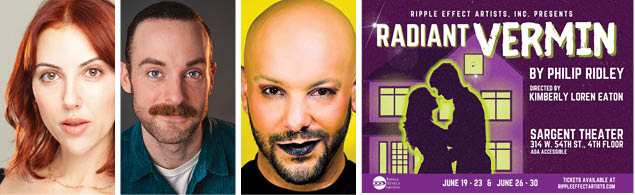
What drew you to being in this production?
BRADDAK: Like some of the best stories, you know the ending at the beginning and you still want to know how it all happens. Also, there was also a buzz of good energy that started at the audition, like the production team really wanted to tell this complex, sensitive story. Going beyond good energy, this team actually connects the production to the greater NYC community through a visible partnership.
MEJIAH: When I originally went into audition I did some research on the show and fell in love with the overall story. I loved the avant garde, whimsicalness of the show and the overall message is very near and dear to my heart, so it felt right to go in and try to be a part of it.
BRILL: I was excited to join this production of “Radiant Vermin” because it mixes dark comedy with some pretty sharp social commentary. Philip Ridley’s writing is thought-provoking and entertaining, offering a critique of consumerism and morality that’s so relevant today. The clever dialogue and the moral dilemmas in the play aren’t just engaging—they also create a rich, dynamic experience for the actors and the audience. Being part of a production that challenges and engages the audience on such a deep level is a thrilling opportunity. I believe in the power of art to change minds and force people to examine their own decisions and their role in creating inequity within society. “Radiant Vermin” does precisely that, making it a project I passionately wanted to be involved in.
Is this script presenting any challenges to you as an actor?
BRADDAK: This is the most complex story I’ve had to portray so far in my career. There is a section where two characters proliferate (if you know, you know). This section was the most exciting, daunting challenge at the start of the rehearsal process.
MEJIAH: I wouldn’t say any challenges , but more a push to think outside of the box. The script alone is great so it’s more of a challenge to figure out how to insert my unique abilities to help highlight these characters in a different way outside of the obvious. It’s been more so fun to explore with different emotions and tactics as I’ve been learning each character’s perspectives within the show.
BRILL: : There are certainly some challenges, which is part of what makes it so exciting to work on! One major challenge is that it’s a three-person play where Jill and Ollie are onstage for the entire show. This demands a lot of stamina and focus, as there’s never a moment to step back and regroup. Plus, the fast-paced, witty dialogue requires precise timing and delivery to capture both the humor and the underlying tension. Another challenge is portraying Jill’s moral transformation in an honest and relatable way. Balancing the dark comedy with the play’s serious ethical questions requires a nuanced performance.
What does the Bowery Mission mean to you?
BRADDAK: Where I know the Bowery Mission and this production connect, is they both shine a spotlight on the realities of those who are climbing the housing ladder and those who are currently unhoused. Thankfully, the Bowery Mission is highlighting the positive change and action that can come from hope. I can appreciate the Bowery Mission because I have worked in the non-profit sector for most of my adult life (mainly the YMCA, AmeriCorps, and higher education), and I have seen the hard work and selflessness it takes to improve someone’s self-esteem, education, work prospects, and life.
MEJIAH: As someone who has experienced homelessness at various points in my life, I am always an advocate for anyone who is able to offer their hand towards this epidemic in our country and appreciate their ability to make this their work.
BRILL: : The Bowery Mission embodies the spirit of giving back and making a tangible difference in people’s lives. It serves as a powerful reminder that we all have a role to play in addressing inequality and supporting those who are less fortunate. Being involved with or supporting an organization like the Bowery Mission is a way to contribute to positive change and uphold the values of empathy and kindness in our society.
What’s next for you?
BRADDAK: Stay tuned! I am grateful for where I am. I hope to be able to keep working hard and doing challenging work that deeply impacts people’s lives for the better.
MEJIAH: I honestly don’t know. As an artist 90% of what I do is audition and submit works so as of now I plan to continue to create and push out new work’s in addition to auditioning and taking long walks with my doggos. I’ve learned to just take things as they come and be open to opportunities to collaborate along the way.
BRILL: : I’m thrilled to share that a film I starred in, “Darkness Upon My Fancy,” is making its rounds in the film festival circuit. It’s a short horror film retelling Frankenstein from a female perspective. This project means a great deal to me, and I’m incredibly proud of the work we did as an entirely female and non-binary identifying cast and crew. Watching it gain recognition at festivals has been a wonderful experience. As for what’s next, I look forward to exploring new opportunities and continuing to challenge myself with diverse and complex roles.
 OUTER-STAGE