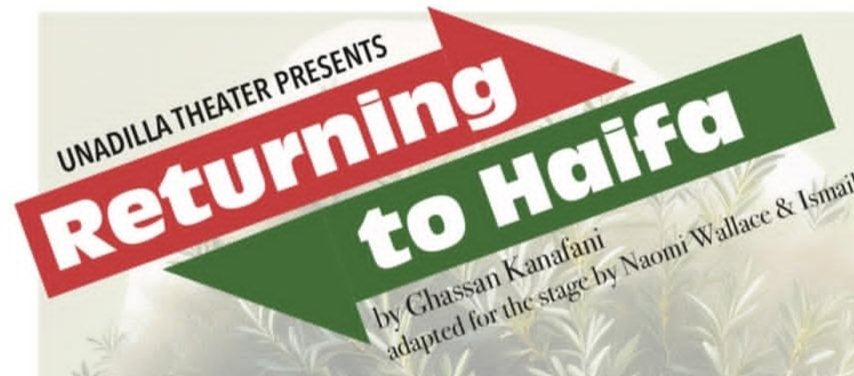
Sometimes, the most efficient and effective way to examine painful, volatile, and complex issues is to take a single example as your focal point. The history of the area we know as the Middle East is complicated, tensions between Palestinians and Israelis backed by years upon years of painful history, and regardless of how much or how little they have actually studied these issues in any sort of detail or how much personal connection they have to that part of the world, these days just about everyone will have an opinion on what is currently happening between Israel and Palestine. It is about the messiest hot button topic in current global politics. Returning to Haifa, adapted by Naomi Wallace and Ismael Khalidi from a novella by Ghassan Kanafani attempts to look at some of these issues through the view of two families bound together by a twist of fate.

A Palestinian couple, driven out of their home in Haifa by British and Israeli forces in 1948 and separated from their five-month-old son in the chaos, determine to return 20 years later after the boarders finally reopen for them. They go to see their former home, and meet the Jewish woman who has been living there, a widow who came from Poland by way of Milan after losing her father to Auschwitz. She welcomes them in, and tells them that when she was given the house, she and her husband adopted the baby who was found there, abandoned in his crib.
The unexpected chance to be reunited, finally, with their lost son who has been brought up Israeli prompts a lot of deep reflection and painful memories.
The script is sympathetic. It takes care to show that all of these people have felt real pain, known real suffering. It doesn’t equate people with governments, and it doesn’t want to say all Israelis are this, all Palestinians are that. There is great care and empathy. The greatest drawback, in my opinion, is the pacing. Perhaps some of it was in the staging or delivery, but it often felt like one monologue following another, which could make it feel like the show was a bit slow. There was a lot of telling rather than showing. But the stories themselves are heart-rending.

This review is for last summer’s performance of the script based on the production by Unadilla Theatre in Vermont. The breakaway moment in that production was Faith Catlin as the widow telling the owners of the house she has been living in for 20 years, the original parents of the boy she raised as her own, the story of how she ended up in Haifa in the first place. Her telling feels natural, her pain and her empathy sincere. It’s a softer sort of pain than the raw hurt we feel from the Palestinian couple. Many of Umer Farooq’s speeches and arguments as the father, Said, are moving and powerful. They hit a nerve, showing someone with a lot of pain and anger trying to do his best, with a pragmatic if cynical bent.
Ultimately I have a deep appreciation for what Returning to Haifa is trying to do. It’s a call for understanding, for cooperation, for kindness. And there are times it hits the mark. But I think there’s something in the writing that likely works better as a novella. There is good work being done to try and talk about important issues, and nothing about it is clumsy or mishandled.
With a bit more polish, it could likely shine as a work of theater. But it doesn’t seem to have quite gotten to its highest potential yet.
 OUTER-STAGE