Here in the United States, a significant portion of the population lives in the financially precarious situation of being one unexpected emergency away from disaster. If not exactly paycheck to paycheck, than with savings that are hardly enough to cover something like a hospital stay or major home repairs in the event of flood or fire damage or any other number of unfortunate events. Sadly, this country has only a fairly minimal social safety net for people in such situations. But despite the small cushion so many Americans have for financial security, very few of us pay much attention to the unhoused. We don’t want to imagine being in their shoes, so we ignore them as much as possible. We don’t think about how they live, and we think even less about how they die and what happens then.
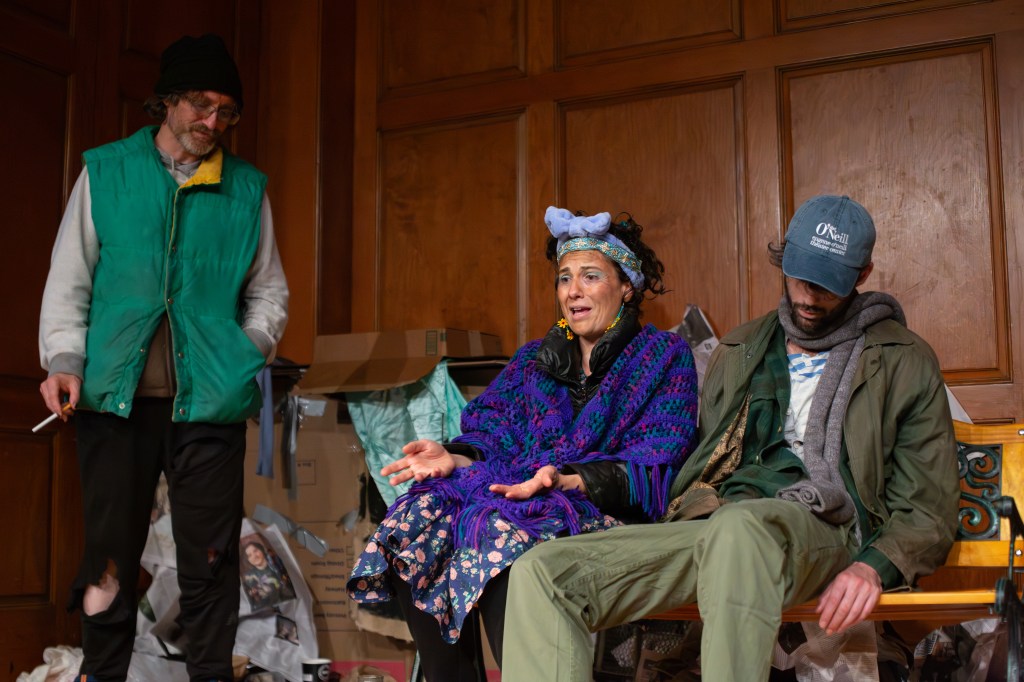
Janusz Glowacki’s play, Antigone in New York, recently presented at A.R.T./New York’s Brooklyn space, looks at how we treat the unhoused and what it means to have dignity in a situation like that, and dignity in death. It focuses on a trio living in Tompkins Square Park, two gentlemen who share a bench, Flea and Sasha, and a woman named Anita. When Anita realizes that the man she loves, Paulie, is no longer in the park or anywhere else to be found, she’s distraught to learn that he froze to death and was taken away to be buried in an unmarked pauper’s grave in Pottersfield, shared with the bodies of strangers who also had no money and no family to bury them. She is convinced that her duty is to make sure Paulie has a proper burial and convinces Flea and Sasha to go on a rescue mission to retrieve his body to bring him back to the park so that at least someone can pay some respects and say a decent goodbye.
Glowacki paints these flawed and hurting people with nuance and care, something that’s incredibly important when trying to portray the unhoused population. They’re always sympathetic. Patrick Leonard, Marcel Parysek, and Netta Toledano give compelling performances. When an NYPD officer addresses the audience and discusses how the police interact with the unhoused, it’s shy of sadistic, but it’s cold. Factual. Devoid of warmth or true understanding. Gaspare Grippi does a fantastic job in the delivery, finding a powerful commanding presence, and it demonstrates a point well even if it sometimes feels like a diversion away from the main trio.
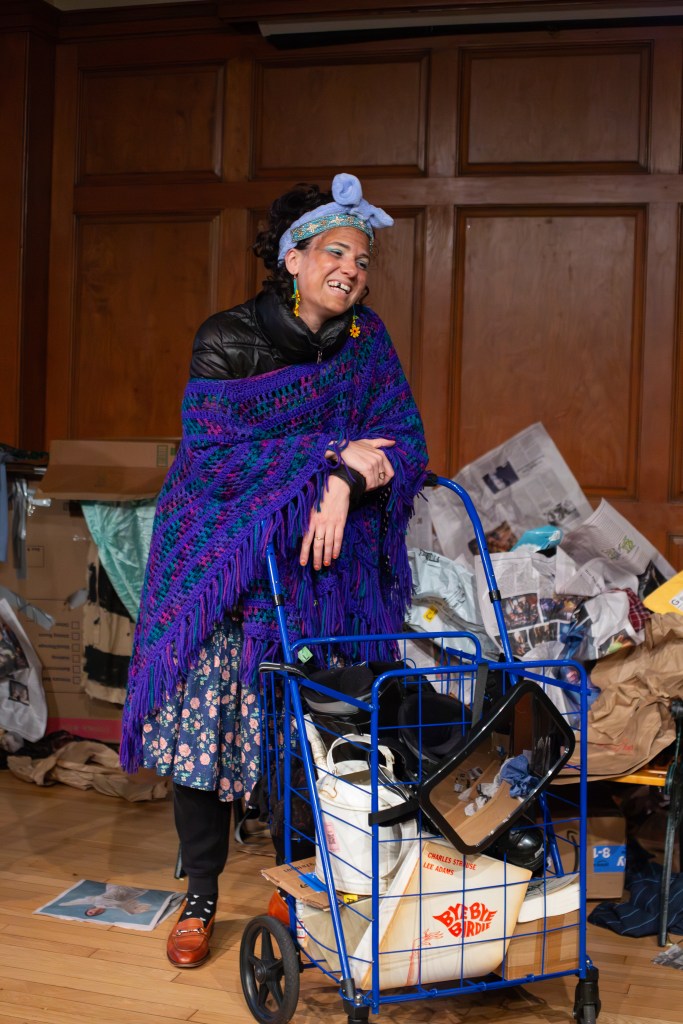
Good performances also help mark a good director, and director Netta Toledano did a phenomenal job staging. She has no issue bringing performers out in the aisles to help engage the audience and make full use of the space, and while there is a lot of dynamic action there are some beautiful still moments that give the space room to breathe nicely and deepen our connection with these people.
Ultimately, this piece did a great job trying to address a delicate and important topic. It felt like it might have taken a few minutes to really take off, but it found its legs nicely. There are reminders in this play that are always timely about the importance of empathy and respect, and that goes a long way.
 OUTER-STAGE