I saw Kierkegaard’s Gun on Wednesday, June 24, at the American Theatre of Actors (ATA) in New York City. I’d first like to say that I found the title compelling, and it immediately piqued my interest. I was a philosophy major and have written on philosophical topics. I’ve also written about Italian American stereotypes, both comically and in a more critical vein.
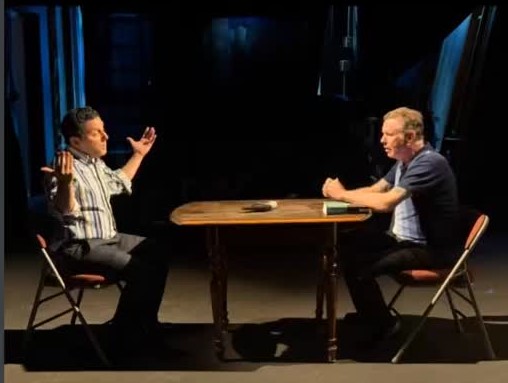
The play opens with the character Les (played by Jim Cleary) sitting at a table with a gun resting on it. Soon, the character Al (played by Roberto Ragone) enters, and the two begin talking.
Early in the conversation, Les refers to the work and personality of Søren Kierkegaard, saying things like, “He was a real depressive type,” and “He was always moaning about how melancholy he was and that it ran in his family.” He also quotes Kierkegaard’s famous assertions that “subjectivity is truth” and “truth is subjectivity.”
As the story unfolds, we learn that Al had an affair with Les’s wife, Adrianna. Following a series of exchanges that are by turns dramatic and comic, Al puts on Stevie Wonder’s “You Are the Sunshine of My Life.” As the two men sing along with the record, Les suddenly shoots Al.
While the actors delivered engaging performances and the writing contained many effective theatrical elements, I struggled to understand the connection between Kierkegaard and the plot. Why Kierkegaard’s gun? Why not Sartre’s—or Nietzsche’s? I think the playwright could do a bit more to clarify that connection for audience members who know something about Kierkegaard while also giving those unfamiliar with him a greater appreciation of his important contribution to European philosophy and literature.
Also, the brevity of the play was fine (it was about ten minutes?), but it felt as though it ended before it fully resolved or offered the audience any real insight.
 OUTER-STAGE