In the heart of New York City’s independent theater scene, a new production is posing a haunting question: In an age of hyper-connectivity, why have we never felt more unheard?
Anya Kai, reporting
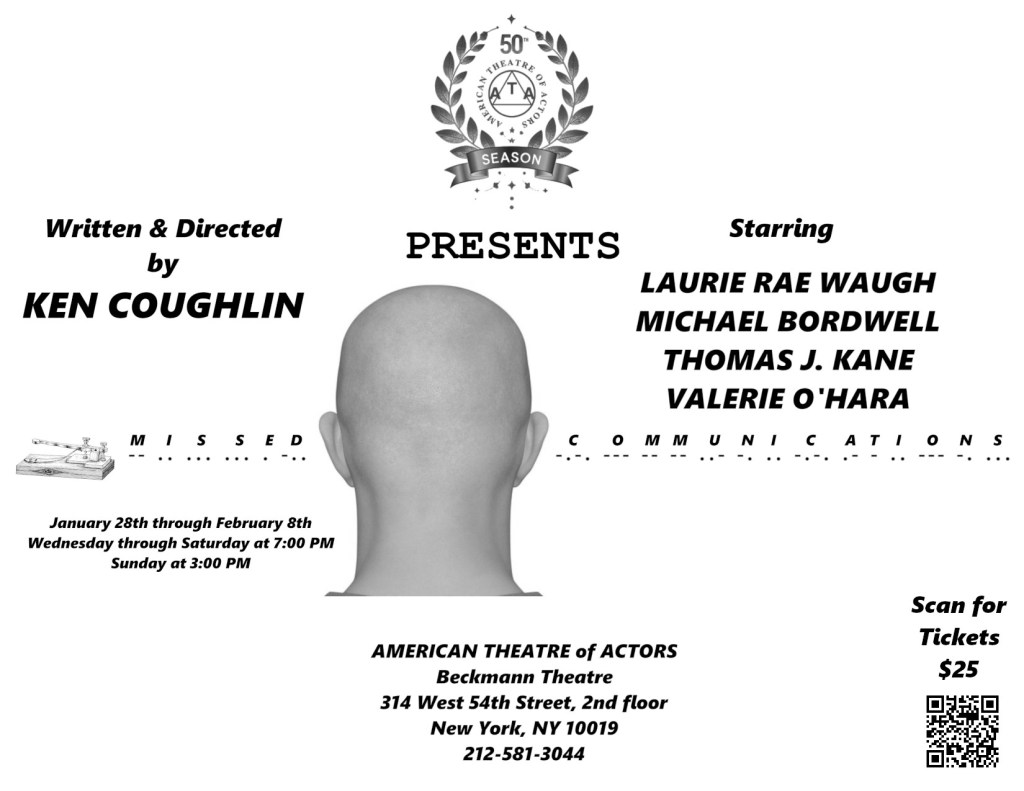
Running since January 28, 2026, at the Beckmann Theatre, American Theatre of Actors (ATA) presents Missed Communications. Written and directed by ATA elder statesman Ken Coughlin, the play serves as a stark mirror to a society that has traded the depth of face-to-face dialogue for the efficiency of a digital ping.
The Anatomy of an Estrangement
The narrative centers on David, a man returning to his family home after five years of total silence. His reappearance acts as a catalyst, forcing his family to confront the “silent gaps” that defined his absence. Through David’s journey, Coughlin explores a universal modern tragedy: the way secrets and unsaid truths calcify into permanent estrangement.
The play is more than a fictional drama; it is a “Production with a Purpose.” Coughlin has woven the real-life story of his dear friend, Michelle Gonzales, into the script following her terminal cancer diagnosis. It serves as a visceral reminder that while we wait for the “perfect time” to communicate, time itself is often running out.
The Tools That Tear Us Apart
The cast of “ATA All-Stars”—including Valerie O’Hara, Thomas J. Kane, Laurie Rae Waugh, and Michael Bordwell—bring a seasoned perspective to the erosion of human connection. The actors themselves observe that the very tools designed to bring us together are the ones facilitating our drift.
Michael Bordwell notes the irony of our current landscape:
“We’ve been given so many tools and options to communicate that the easiest one often wins. Texts, voicemails, voice memos—even memes—have replaced a lot of face-to-face interaction.”
Bordwell acknowledges that while these digital shortcuts can reduce stress or accommodate mental health needs, they often come at the cost of “real communication.” The choice to connect deeply is becoming an active, difficult decision rather than a natural state of being.
A Lost Art Form
For Laurie Rae Waugh, the issue is generational and systemic. She posits that younger generations are losing the “art of conversation” entirely.
“Times were much simpler without cell phones,” Waugh reflects. “People would make the time to meet… for a coffee, dinner, or just to go out for a walk. Now, everyone is too busy to spend quality time together.” She suggests that the only way back to authentic connection is a collective, conscious effort to “slow down” and rediscover the joy that a nuanced, physical conversation brings to the world.
Why Theatre Matters Now
If we have lost the gift of community, theatre like Missed Communications acts as an intervention. It requires an audience to sit in the dark, put away their phones, and witness the friction of human beings in a room together. It forces us to look at the “missed communications” in our own lives before they become irreversible.
As the play navigates the startling truth behind David’s return, it challenges the audience: Will you wait for a crisis to speak your truth, or will you choose connection while you still have the time?
Listing Information
- WHAT: Missed Communications by Ken Coughlin
- WHEN: January 28 – February 8, 2026
- SCHEDULE: Wed. through Sat. at 7:00 p.m.; Sundays at 3:00 p.m.
- WHERE: The Beckmann Theatre, ATA Complex (314 W 54th St, NYC)
- TICKETS/INFO: www.americantheatreofactors.org
- SUPPORT: To offer support to Michelle Gonzales and her family, visit the link provided on the ATA website.

